


Walking the Balance Beam of Fla. Stat. § 738.409: Allocating Payments From An Individual Retirement Account To A Trust
By Alexander M. Parthemer, LL.M. (Tax), of Jones Foster, West Palm Beach; Sasha A. Klein, LL.M. (Tax), of PwC US, Palm Beach Gardens; and David S. Sennett, LL.M. (Tax), of Independent IRA Consultant, Creve Coeur, Missouri
Watching an Olympic gymnast perform the balance beam exercise provides insight into allocating payments from an individual retirement account (IRA) to a postmortem trust. Flawless execution of a planned program leads to a perfect dismount. In the context of trust administration, a perfect dismount translates into accurately allocating (balancing) a payment between income and principal. Unless the governing instrument directs allocation or gives the trustee discretion, Florida law determines the result through its principal and income act.
As of January 1, 2025, the Florida Uniform Fiduciary Income and Principal Act (FIPA), codified in Chapter 738,[1] rewrites the allocation rule under the newly numbered Fla. Stat. § 738.409, titled Deferred Compensation, Annuity, or Similar Payment. Drawing in part from Section 409 of the 2018 Uniform Fiduciary Income and Principal Act, Fla. Stat. § 738.409 (replacing the former rule under Fla. Stat. § 738.602) governs the allocation of payments from a wide range of “separate funds,” including pensions, annuities, deferred compensation plans, and retirement accounts. The revised allocation rule requires the trustee to ensure payments to the trust include the total of the separate fund’s internal income during an accounting period. If the internal income allocated to the trust is less than the total, special adjustment provisions apply to trusts with beneficiaries entitled to all the trust’s income.
For purposes of this article, the discussion is limited to one of the most common and complex scenarios: the receipt of IRA distributions by a trust after the account owner’s death. Fla. Stat. § 738.409 carries forward the central principle from prior law that the fiduciary must treat the income of the separate fund as income of the trust, but it does so within a more detailed structure. The section introduces new definitions, refreshes existing ones, and reaffirms calculation methods to determine the IRA’s internal income created under the former statute. Combined with the new allocation rule, they significantly impact trustees administering trusts receiving IRA payments. Fla. Stat. § 738.409 concludes with a “safe harbor” provision enabling trustees to continue administering determination of the IRA’s internal income and allocation in the manner used prior to FIPA’s effective date.
Operative Terms:
Separate Fund. Fla. Stat. § 738.409(1)(f) defines a “separate fund” as an arrangement, including an IRA, that holds assets exclusively for the benefit of a single participant or account owner. A separate fund is distinct from the trust’s own assets and accounting structure. This distinction is critical, as Fla. Stat. § 738.409 requires the fiduciary to determine the fund’s “internal income” and allocate payments from that fund to the trust.
Internal Income of the Separate Fund. Under Fla. Stat. § 738.409(1)(a), “internal income” refers to the income generated within the separate fund, determined in accordance with Fla. Stat. § 738.409(2). The fiduciary must either calculate this amount using the traditional fiduciary accounting method (treating the fund as if it were a trust subject to FIPA), or apply the percent calculated method, as described below.
Payment. A “payment” includes any amount a fiduciary receives from a separate fund, whether paid in installments over a fixed term, over one or more lifetimes, or in a lump sum. Distributions from an IRA, including required minimum distributions (RMDs), fall under “payment,” and are subject to allocation between income and principal under Fla. Stat. § 738.409(3).[2]
Percent calculated. Fla. Stat. § 738.409(1)(e) defines the “percent calculated” as a percentage between three and five percent, determined either by reference to the § 7520 rate under the Internal Revenue Code or as established by an independent fiduciary as defined in Fla. Stat. § 738.102(9). The percent calculated method functions as a simplified unitrust approach for determining internal income, often providing administrative ease and predictability.
Marital Trust. A trust qualifying for the estate tax marital deduction under the Internal Revenue Code or otherwise qualifying for a marital deduction.[3]
Related Terms Impacting Fla. Stat. § 738.409:
Accounting Period. This “term means a calendar year unless the fiduciary selects another period of 12 calendar months or approximately 12 calendar months.” The accounting period is the time frame during which the fiduciary determines the separate fund’s internal income and the allocation of any payments from the fund.[4]
Fiduciary. FIPA groups a trustee under the definition of “fiduciary.”[5]
Determination of the IRA’s Internal Income
For an IRA, Fla. Stat. § 738.409(2) provides two methods for determining “internal income” during the accounting period. Each method aims to identify how much of the IRA’s earnings should be treated as income of the trust, but they differ in complexity, flexibility, and the level of detail required.
METHOD ONE: Traditional Fiduciary Accounting Method (Fla. Stat. § 738.409(2)(a)):
Under the first approach, the trustee determines the IRA’s internal income as if the IRA were a trust subject to FIPA. In practice, the trustee relies on the IRA administrator’s statements, which should identify receipts and expenses classified under FIPA as income or principal. This method mirrors traditional fiduciary accounting for ordinary trust assets, where income items such as dividends and interest are separated from principal items such as capital gains or unrealized appreciation.
This method tracks the account’s actual performance during the accounting period, when the IRA administrator supplies detailed reporting; however, its applicability may be cumbersome if the administrator’s statements do not readily distinguish income and principal components.
CASE STUDY: The Josephine Trust
Josephine, who died in 2023 at age 80, established a trust for the benefit of her surviving spouse and their children. The trust does not qualify for the marital deduction, making it a non-marital trust. Her surviving spouse is entitled to all net income, while the children are the remainder beneficiaries.
Desmond, Josephine’s close friend, serves as trustee of the trust. Josephine designated the trust as beneficiary of her Traditional IRA. Since Josephine’s death, Desmond has withdrawn the annual required minimum distributions (RMDs) payable to the trust. The RMDs, determined under Internal Revenue Code § 401(a)(9)(H) and the corresponding final Treasury Regulations, must be distributed over a ten-year period, based on the surviving spouse’s life expectancy for the first nine years, with the entire remaining balance distributed in year ten.[6]
For the IRA, Desmond receives monthly statements from the plan administrator, which he requested be prepared consistent with fiduciary accounting principles. These statements identify the IRA’s internal income using the traditional fiduciary accounting method.
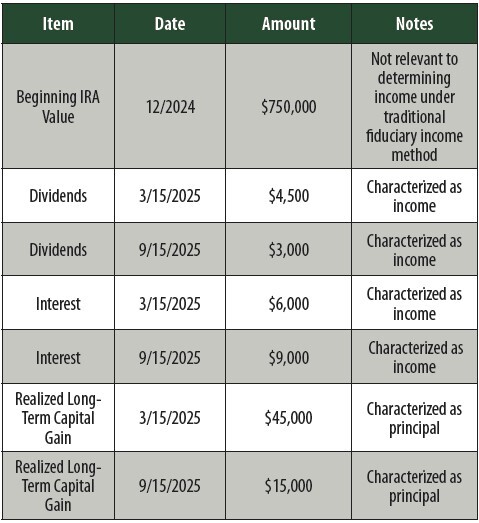
These entries allow Desmond to identify the IRA’s internal income, which for the accounting period totals $22,500.
METHOD TWO: Percent Calculated Method (Fla. Stat. § 738.409(2)(b)):
Alternatively, the trustee may elect to deem the IRA’s internal income to equal a fixed percentage, between three percent and five percent, of the IRA’s value as of the statement date immediately preceding the start of the accounting period. This approach, called the “unitrust method,” in the former statute, simplifies administration by using a consistent rate in place of detailed accounting.
Notice and Flexibility. If the trustee uses the percent calculated method, Fla. Stat. § 738.409(2)(b) requires disclosure to the beneficiaries in a trust accounting or a written notice meeting the standards of Fla. Stat. § 736.1008(4)(c). The statute also allows flexibility under Fla. Stat. § 738.409(2)(d), permitting the trustee to change from one method to the other in future accounting periods to reflect administrative or investment circumstances.
CASE STUDY:
Continuing the Josephine Trust Case Study, assume Desmond elects to use the percent calculated method. By selecting a four percent rate, Desmond determines the IRA’s deemed internal income for the year is $30,000. This figure is treated as the IRA’s internal income, regardless of the fund’s actual dividends or capital gains.
By contrast, the traditional fiduciary accounting method tracks the internal income during the accounting period. Its execution, however, depends on the IRA administrator providing detailed reporting. The percent calculated method simplifies the determination of internal income, but will not reflect actual performance during the current accounting period. Trustees should weigh these factors carefully and document their reasoning to preserve FIPA’s presumption that their determinations are reasonable and fair to all beneficiaries under Fla. Stat. § 738.201(2).
ALLOCATION: The Heart of Fla. Stat. § 738.409
The most critical element of Fla. Stat. § 738.409 is found in subsection (3), which governs how a trustee must allocate payments from a separate fund between income and principal. The statutory directive provides:
(3) A fiduciary [trustee] shall allocate a payment from a separate fund during an accounting period to income to the extent of the internal income of the separate fund during the period and allocate the balance to principal (emphasis supplied).
This rule turns on a simple but significant question: Is the amount withdrawn from the IRA over or under the IRA’s internal income for the trust’s accounting period?
Over. If the amount withdrawn from an IRA exceeds the internal income as of the payment date, then the balance is allocated to principal; however, the text in subsection (3) complicates the allocation analysis. Given that the IRA continues to generate income after the withdrawal, the trustee may need to reallocate amounts previously assigned to principal if the IRA earns additional internal income before the end of the accounting period. In other words, what appears balanced at the time of payment may require reallocation once the total internal income is known.
The allocation provision of Fla. Stat. § 738.409(3) marks a clear departure from prior law. The former governing statute allocated to trust income, as of the payment date, the lesser of the IRA’s internal income or the payment itself.[7] If the payment occurred before the end of the trust’s accounting period, the statute imposed no duty on the trustee to allocate the IRA’s internal income earned following the payment date.
CASE STUDY CONTINUES: The Balancing Act Begins
Using the same facts as above, the following scenario focuses on allocating a required minimum distribution (RMD) between income and principal. The same analysis applies to any IRA payment received by a trust, even if not required under the Internal Revenue Code.
1. The “Over” – When an IRA Payment is Greater than the Amount of Internal Income Earned during Trust’s Accounting Period
For 2025, the RMD payable to Josephine’s trust is $50,000. Desmond withdraws the entire RMD on June 1. On that date, the internal income was only $10,500. With this information, Desmond allocates the RMD on the trust’s books as follows: $10,500 to income and the balance, $39,500 to principal. The IRA administrator’s statements also show the account will earn an estimated $12,000 of internal income following the RMD payment.
Fla. Stat. § 738.409(3), however, compels a trustee to allocate a payment to trust income to the extent of the IRA’s internal income earned during the entire accounting period, not merely as of the payment date. This means if the IRA earns more income later in the year, Desmond must reallocate part of the earlier principal allocation back to income.
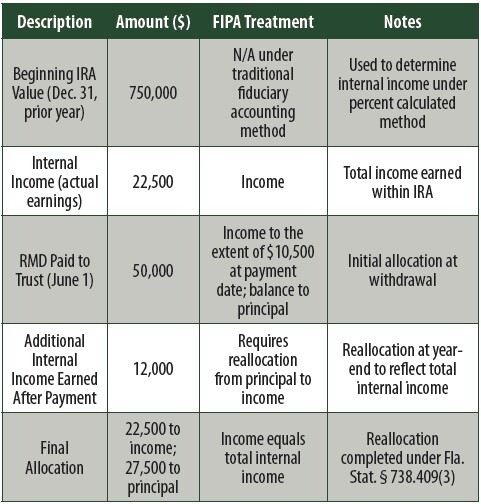
How can Desmond mitigate the risk of misallocation posed by the process under Fla. Stat. § 738.409(3)?
- Delay the withdrawal. Desmond could postpone the RMD until the end of the trust’s accounting period, typically December 31. By that date, he would know the total internal income earned for the year and could allocate it in one step. Using the example above, if the IRA’s total internal income is $22,500, Desmond would allocate $22,500 to income and $27,500 to principal.
- Match withdrawals to the income cycle. Desmond could divide the annual RMD into equal monthly withdrawals. At the end of each month, he would review the IRA administrator’s statement to determine the internal income for that period. If a monthly withdrawal exceeds the internal income, the excess is allocated to principal. This approach smooths income flow and reduces year-end reallocations.
- Maintain a shadow accounting. Desmond could establish a parallel record to track internal income and reallocations throughout the year. The accountant would document each reallocation and adjust the trust’s books accordingly. For accuracy, Desmond might create a sub-account to hold IRA payments during the year, recording each reallocation between income and principal. In practice, this may require monthly reallocations, since the surviving spouse is entitled to receive all trust net income each month.
- Use the safe harbor provision. Fla. Stat. § 738.409(7) allows a trustee who was administering a fund before January 1, 2025, to continue allocating payments under the prior law, Fla. Stat. § 738.602(4). Desmond began administering Josephine’s trust before FIPA’s effective date and historically allocated the lesser of the internal income or the payment amount to trust income. Subsection (7) expressly authorizes this approach for trusts established before 2025.
CAUTIONARY NOTE: Assume Josephine’s trust was created on or after FIPA’s effective date. Desmond CANNOT rely on Fla. Stat. § 738.409(7) for any trust accounting period beginning on or after January 1, 2025.
2. The “Under” – When an IRA Payment is Less than the Amount of Internal Income Earned: §738.409(5), The “Great Equalizer”
Subsection 738.409(5) addresses the situation where the income earned within the IRA during the accounting period exceeds the amount distributed to the trust. This rule applies to a specific class of non-marital trusts in which one or more beneficiaries are entitled to receive all current net income each year. Its purpose is to ensure the income beneficiary receives the full measure of income attributable to the IRA, even if the trustee’s withdrawals fall short of the account’s internal income.
Assume for 2026, Josephine’s IRA earns $35,000 of internal income during the trust’s accounting period, but the RMD payable to the trust is only $30,000. Desmond withdraws the full RMD in December and allocates the entire payment to trust income. At year-end, the IRA administrator’s statements confirm the total internal income of $35,000, revealing that $5,000 of income remains undistributed.
Under Fla. Stat. § 738.409(5), Desmond must transfer that $5,000 from principal to income and distribute it to the surviving spouse, who is entitled to all current net income of the trust. This transfer (adjustment) ensures the trust’s total reported income equals the IRA’s internal income for the year.
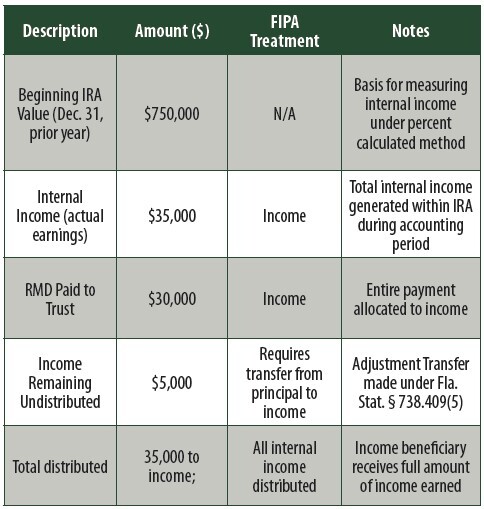
This “equalizer” provision serves as a corrective mechanism, ensuring the income beneficiary receives the full amount of income generated within the IRA, regardless of whether the distributions from the account match that income. In this example, Desmond’s transfer reduces principal by $5,000, but it fulfills the statutory requirement to deliver all current net income to the current beneficiary (surviving spouse).
Had Desmond failed to perform the transfer to the spouse (or any current beneficiary entitled to all the trust’s income), they would not have received all the IRA’s internal income. The transfer mechanism therefore protects the trustee from potential claims of under-distribution of the fund’s internal income, and maintains parity between the IRA’s internal accounting and the trust’s fiduciary accounting.
Pondering the allocation complexities created by Fla. Stat. § 738.409(3)
After working through the complications of reallocating between income and principal under Fla. Stat. § 738.409(3), Desmond begins to look for a simpler approach. Rather than monitoring the IRA’s internal income throughout the year and making periodic reallocations, he considers using the percent calculated method under Fla. Stat. § 738.409(2)(b).
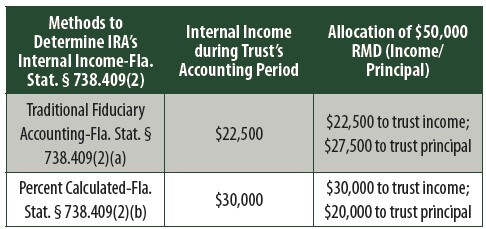
As an independent trustee, Desmond select a four percent rate and multiplies it by the IRA’s market value as of the prior year-end. The IRA was valued at $750,000, producing deemed internal income of $30,000 for the 2025 accounting period. Reliance on the percent calculated method eliminates the need to monitor the fund’s characterization of receipts and expenses as income or principal during the trust’s accounting period.
Applying Fla. Stat. § 738.409(3), Desmond allocates the $50,000 RMD as follows: $30,000 to income (representing the IRA’s internal income) and the remaining $20,000 to principal. The allocation process is straightforward and final, without the need for later rebalancing.
While the percent calculated method simplifies administration, Desmond recognizes its impact on beneficiaries. This method often increases the amount allocated to income, benefiting the current income beneficiary but reducing the remaindermen’s share. In Josephine’s trust, the surviving spouse’s current income increases by $7,500 compared to the traditional fiduciary accounting method, as shown below.
However, the trustee must weigh this outcome against other circumstances. In this case, surviving spouse’s” sole entitlement is to the trust’s net income. The terms of the trust do not authorize discretionary distributions of principal under any standard. The trustee could lower the percentage to calculate the internal income, reducing the difference produced by the two methods.
Regardless of which approach the trustee selects, FIPA provides statutory protection. Fla. Stat. § 738.201(2) presumes a trustee’s determinations under FIPA are “fair and reasonable to all beneficiaries.” In practical terms, this presumption places the burden of proving an abuse of discretion on any beneficiary who challenges the trustee’s decision.
Marital Trusts
Fla. Stat. § 738.409(4) serves as the default mechanism to preserve the federal estate tax deduction, if the terms of the trust do not require withdrawal of all the IRA’s internal income and distribution to the surviving spouse. By granting the surviving spouse an election to receive this amount, Fla. Stat. § 738.409(4) ensures a marital trust remains compliant with Internal Revenue Code § 2056(b)(7) and Internal Revenue Service Revenue Ruling 2006-26.[8] Together, they direct that the spouse be entitled to all trust income and to the separate fund’s internal income.
Application of §738.409(4) is conditional and operates only when the amounts allocated to income following payment/withdrawal from the separate fund are less than the fund’s total internal income and the terms of the trust do not require the trustee to withdraw the IRA’s internal income and distribute it to the surviving spouse. The subsection then imposes three corresponding fiduciary duties:
- Withdrawal Obligation (Fla. Stat. § 738.409(4)(a)). The fiduciary must withdraw from the separate fund (such as an IRA) the amount requested by the surviving spouse, up to the amount by which the fund’s internal income for the accounting period exceeds the amount otherwise received by the trust during that period. In other words, if the IRA earns more than the trustee has withdrawn, the spouse may compel the trustee to withdraw the difference as additional income. Conversely, if the trustee withdraws amounts equal to or exceeding the IRA’s internal income allocated under Fla. Stat. § 738.409(3), the surviving spouse loses the election to compel further distributions.
- Transfer Obligation (Fla. Stat. § 738.409(4)(b)). If, after all the payments from the IRA, including those made pursuant to the withdrawal obligation, the surviving spouse still has not received the full amount of the IRA’s internal income for the accounting period, the spouse may require the trustee transfer an additional amount from principal to income. The amount transferred may not exceed the difference between the IRA’s total internal income for the period and the payments already received after applying paragraph (a). Upon such a request, the trustee must make the transfer and treat the amount as income distributable to the surviving spouse.
- Distribution Obligation (Fla. Stat. § 738.409(4)(c)). Finally, the trustee must distribute to the surviving spouse, as income, both: (1) the internal income of the separate fund received or withdrawn during the accounting period, and (2) any principal transferred to income under paragraph (b).
Together, these provisions guarantee the surviving spouse receives all income attributable to the IRA, either through actual payments or through transfers from principal.
CASE STUDY: The Arthur Trust
Arthur, Josephine’s surviving spouse, continues to receive income from Josephine’s Trust for several years. When Arthur later dies, his estate plan provides for a marital trust benefiting his surviving spouse, Margaret, bringing the provisions of Fla. Stat. § 738.409(4) into focus.
Assume under Arthur’s estate plan, his IRA is payable to a Qualified Terminable Interest Property (QTIP) Trust for Margaret’s benefit. During 2027, the IRA generates $40,000 of internal income under the traditional fiduciary accounting income method, but the IRA administrator only distributes $30,000 to the trust.
Margaret elects to receive the full amount of internal income for the accounting period. Under Fla. Stat. § 738.409(4)(a), the trustee must, upon her request, withdraw from the IRA an amount not greater than the excess of the IRA’s internal income over the payments already received. Accordingly, the trustee withdraws the additional $10,000 directly from the IRA and distributes the entire $40,000 to Margaret.
Alternatively, instead of withdrawing the internal income, Margaret requests that the trustee transfer the shortfall from principal to income to satisfy her income entitlement. Upon such a request, the trustee transfers principal to income.
Under Fla. Stat. § 738.409(4)(c), the trustee must then distribute to Margaret, as income, both: (1) the $30,000 of internal income received or withdrawn during the year and (2) any principal transferred to income. This results in a total income distribution of $40,000, as illustrated below.
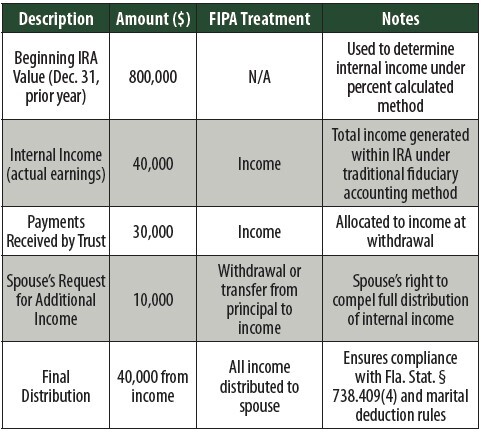
From an administrative standpoint, trustees should anticipate potential spousal elections and coordinate early with IRA administrators to confirm whether additional withdrawals are permissible. If the account restricts further distributions, for example, amounts exceeding the RMD, the trustee must honor the spouse’s election by transferring the appropriate amount from trust principal to income and documenting the adjustment in the trust’s accounting records.
For estate planners, Fla. Stat. § 738.409(4) underscores the importance of drafting marital trusts integrating both federal and Florida requirements.
If practitioners intend to rely on Fla. Stat. § 738.409(4), they should consider these points in drafting marital trusts:
- Instruct the trustee to notify the surviving spouse if the amounts received from the IRA during the accounting period do not include all the internal income.
- Clarify the scope of the trustee’s authority whether it must withdraw all the IRA’s internal income or only upon the spouse’s request.
- Define “income” to include both actual and deemed internal income (principal transferred to income if the actual internal income is less than the amounts received from any IRA or similar account payable to the trust).
- Grant the trustee explicit authority to make withdrawals or transfer principal to income to satisfy the spouse’s entitlement.
- Ensure the income distribution provisions align with the marital deduction requirements under Internal Revenue Code (IRC) § 2056(b)(7) and Revenue Ruling 2006-26.
- Require the trustee to document any withdrawals or transfers relying on Fla. Stat. § 738.409(4).
In practice, Fla. Stat. § 738.409(4) functions as a statutory safeguard. It ensures a marital trust receiving IRA distributions remains compliant with both state allocation rules and federal tax law when the payments from the IRA are less than the account’s internal income.
Safe Harbor Provision for Administrations Begun Prior to January 1, 2025
Fla. Stat. § 738.409(7) allows trustees to continue determining the IRA’s internal income and allocation of amounts received, if administration began prior to FIPA’s effective date, January 1, 2025. Trustees may choose “to determine a separate fund’s internal income, allocate payments and account for unwithdrawn internal income” under Fla. Stat. § 738.409(5), or, alternatively, to continue administering the fund in the same manner used before FIPA took effect. Subsection (7) expressly emphasizes the trustee “is not required to consider the [transfer provision] in Fla. Stat. § 738.409(5)” if the separate fund’s internal income exceeds the amount(s) withdrawn from the fund. In practical terms, this means a trustee who has historically allocated IRA payments under prior law (former Fla. Stat. § 738.602) may continue doing so, even after 2025, provided the administration of the fund began before FIPA’s effective date. This transitional rule offers administrative continuity and minimizes disruption for trustees already managing existing trusts tied to IRAs or other separate funds.
Conclusion
Fla. Stat. § 738.409 serves two purposes. First, it provides a detailed statutory framework for determining and allocating income and principal when the governing instrument is silent. Second, and equally important, the potential challenges created under the allocation rule embodied in Fla. Stat. § 738.409(3) invite the trust drafter to contemplate custom-tailored language to determine internal income and also its allocation between principal and income. Fla. Stat. § 738.201(1)(d) makes it clear that the statute’s allocation rules yield to the express terms of the governing instrument. Therefore, thoughtful drafting remains the best protection against administrative uncertainty or beneficiary disputes.[9]
On a related note, the trust drafter’s duties do not end with producing a governing instrument. After consulting with the client, the drafter should ensure the IRA administrator’s statements disclose sufficient information to determine the IRA’s income and its allocation. Among the questions to be considered:
- Can the IRA administrator correctly allocate receipts and expenses between income and principal?
- Can the trustee readily identify the IRA’s internal income earned during the trust’s accounting period?
- Is the trustee comfortable using the traditional fiduciary accounting method to determine the IRA’s internal income and its allocation following payment?
- If the answer to the last question is “NO,” does the trustee know how to apply the percent calculated method to determine and then allocate the IRA’s internal income earned during the trust’s accounting period?
- If a bank’s trust department is administering the IRA, does it split administration between a centralized IRA team and a trust officer overseeing the beneficiary trust? Does the team coordinate payments and their allocation?
Mastering the intricacies (or knowing the hidden traps) of Fla. Stat. § 738.409 poses challenges to trust administration. Access to competent counsel and an informed IRA administrator will keep the trustee’s balancing act under control. For further assistance, members of the Section can use the Principal and Income Committee’s hypotheticals located on its website home page to examine multiple scenarios.[10]
Endnotes
[1] Ch. 2024-216, Fla. Laws § 28 at 38 available at http://laws.flrules.org/. (last visited Sept. 7, 2025)
[2] Fla. Stat. § 738.409(1)(d) (2025).
[3] Fla. Stat. § 738.409(1)(b) (2025).
[4] Fla. Stat. § 738.102(1) (2025).
[5] Fla. Stat. § 738.102(9) (2025).
[6] Treas. Regs. § 1.401(a)(9)-5(e)(2) (annual RMDs for years one through nine, full distribution in year 10); Treas. Regs. § 1.401(a)(9)-5(d)(1)(ii), (f)(1)(i) (the RMD is payable over the longer of the oldest trust beneficiary’s life expectancy or deceased IRA owner’s hypothetical single life expectancy remaining at death); for a more detailed explanation of the treasury regulations minimum distribution rules, see David Sennett, The Twin Pillars of Required IRA Distributions to a Trust, Trusts and Estates (June 2025) at 38, available at trustsandestates.com.
[7] Fla. Stat. § 738.602(4) (2025).
[8] 006-22, Internal Revenue Bulletin 939.
[9] The second portion of the article cited in endnote 6 deals with issues arising from applying § 409 of the uniform act (UFIPA), including determination of the separate fund’s internal income and the allocation “over/under” analysis. The article does not address Florida’s version of § 409.
[10] Available at rpptl.org (last visited Sept. 10, 2025).
© 2026 This article was originally published in the Spring 2026 issue of ActionLine, a Florida Bar Real Property, Probate and Trust Law Section publication.
The information provided in this article does not, and is not intended to, constitute legal advice; it is for general informational purposes only. No reader of this article should act or refrain from acting on the basis of this information without first seeking legal advice from counsel in the relevant jurisdiction to ensure the information contained herein – and your interpretation of it – is applicable or appropriate to your particular situation.
Alexander M. Parthemer, LL.M., a member of Jones Foster’s Private Wealth, Wills, Trusts & Estates and Corporate & Tax teams, focuses his practice in the areas of estate planning, probate and trust administration, tax planning, business planning, and transactional corporate law. Alex is an active member of the Real Property, Probate & Trust Law Section of The Florida Bar and the Tax Section of The Florida Bar. He holds a Master of Laws degree (LL.M.) in Taxation from the Graduate Tax Program at the University of Florida.
Sasha Klein is a Tax Partner in PwC’s Private practice and Co-Chair of the PwC Trust & Estate Academy, advising ultra-high-net-worth individuals and business-owning families on sophisticated wealth, transfer tax, and legacy planning. Her practice includes QSBS planning, family offices, private trust companies, and multigenerational governance. Before joining PwC, Sasha was a law firm partner and Chair of its Estate and Tax Planning group, where she built a nationally recognized practice. She also served as fiduciary counsel to a prominent multi-family office. Sasha holds a J.D. from Vanderbilt and an LL.M. in Taxation from the University of Florida.
David Sennett holds an L.L.M from DePaul University. After spending two decades managing risk for bank IRA units, he now serves as an independent risk consultant.
About Jones Foster
Jones Foster is a full-service commercial and private client law firm headquartered in West Palm Beach, Florida, with offices in Palm Beach and Jupiter. Tracing its roots back to 1924, the firm has served as an integral part of South Florida’s growth and prosperity. Through a relentless pursuit of excellence, Jones Foster delivers original legal solutions that help clients, colleagues, and the community to move forward. A significant number of attorneys have received the designation of Board-Certified Specialist by The Florida Bar in their specific practice area. The firm’s practice groups include Complex Litigation & Dispute Resolution; Corporate & Tax; Land Use & Governmental; Private Wealth, Wills, Trusts & Estates; Real Estate; and Trust & Estate Litigation. For more information, please visit www.jonesfoster.com.