

Florida’s Principal and Income Act Gets a Refresh
By Alexander M. Parthemer of Jones Foster P.A., West Palm Beach, Florida, and Sasha A. Klein of PwC US, Palm Beach Gardens, Florida
Florida’s principal and income act receives an update! Introducing the Florida Uniform Fiduciary Income and Principal Act (“FIPA” or the “Act”).[1] FIPA modernizes Florida’s previous act from 2002, known as the Florida Uniform Principal and Income Act (“FUPIA”). Located at Chapter 738 of the Florida Statutes, FIPA governs how receipts and disbursements are allocated between income and principal for trusts and estates when the governing document doesn’t specify. FIPA integrates language from the Uniform Law Commissioners (“ULC”)[2] 2018 Uniform Act wherever practical while maintaining key public policy choices that remain relevant for Florida. Given the extended duration of trusts and the increasingly blurred distinction between income and principal resulting from flexible drafting and the modern portfolio theory, these allocation rules needed a refreshing.
A theme woven throughout the fabric of FIPA is flexibility. This flexibility is designed to facilitate the administration of trusts and estates and provide predictability to beneficiaries. Though all its provisions deserve thorough understanding, this article highlights ten of the more significant changes.
Legislative Background
In 1997, the ULC published the Uniform Principal and Income Act (the “1997 Uniform Act”).[3] The 1997 Uniform Act was adopted – with modifications – in Florida in 2002, named the Florida Uniform Principal and Income Act (“FUPIA”). For over two decades, the 2002 Act has effectively benefitted our state. Over the years, Florida has enacted a few tweaks to it, with the adoption of unitrust rules arguably the biggest.[4] In 2018, the ULC published an update, titled the Uniform Fiduciary Income and Principal Act (the “2018 Uniform Act”). The Real Property, Probate and Trust Law Section of the Florida Bar formed a committee to review the 2018 Uniform Act and decided it was time to update FUPIA. The new Florida act, FIPA, adopts the 2018 Uniform Act as the default structure, but retains the meaningful modifications unique and still relevant to Florida.[5] Passed in 2024 and largely effective as of January 1, 2025, FIPA marks Florida as the eighth state to adopt this model legislation. This move not only improves Florida's attractiveness for trust administration but also addresses some of the challenging issues within the current law.
A fiduciary must act impartially among beneficiaries unless the governing document specifies otherwise. Additionally, fiduciary actions taken under FIPA are presumed to be fair and reasonable.[6] This presumption supports the fiduciary and highlights FIPA's goal of ensuring fairness in fiduciary behavior.
10 Key Changes
- Definitions
FIPA revises Fla. Stat. § 738.102 (2024) to modify existing definitions and provide some new definitions. Below are some of the definitions that were changed in a substantive way and a few new definitions. Worth noting first, the definitions of “accounting period,” “income,” “mandatory income interest,” and “person” remain unchanged, while definitions for new terms, including “court,” “estate,” “personal representative,” and “record,” were added without impacting current policy.
Definitions that were changed:
- Beneficiary – is redefined to distinguish between current income beneficiaries and current remainder beneficiaries and includes individuals holding life estates or term interests.
- Fiduciary – is expanded to encompass not just the personal representative and trustee, as defined by current law, but also those with a power to direct, those acting under a fiduciary’s delegation, and those holding property for a successor beneficiary who may be impacted by principal or income allocations.
- Income interest – is now defined as a right of a current income beneficiary, which includes a current beneficiary’s use of property held by a fiduciary.
- Net income – is expanded to encompass its application to a unitrust and adjustments from income to principal.
- Principal – has been redefined from referring to that which is distributed to a remainder beneficiary to encompass that which is held for distribution to, for the productions of income for, or for us by, a current or successor beneficiary.
Definitions that were added:
- Distribution – a payment or transfer by a fiduciary to a beneficiary in the beneficiary’s capacity as a beneficiary, without consideration other than the beneficiary’s right to receive the payment or transfer under the terms of the trust, will, life estate, or term interest.
- Independent person – a person that is not:
- For a trust, a qualified beneficiary; a settlor; an individual whose legal obligation to support a beneficiary may be satisfied by a trust distribution; or any trustee whom an interested distributee may remove and replace with a related or subordinate party.
- For an estate, a beneficiary; a spouse, parent, brother, sister, or issue of specified persons; a corporation, partnership, limited liability company, or other entity in which specified persons have voting control; or an employee of a specified person.
- Personal representative – an executor, administrator, successor personal representative, special administrator, or person that performs substantially the same function with respect to an estate under the law governing the person’s status.
- Record – information that is inscribed on a tangible medium or stored in an electronic or other medium and is retrievable in perceivable form.
- Special tax benefit – the annual gift tax exclusion,[7] qualified subchapter S status,[8] federal marital tax deduction,[9] and generation-skipping transfer tax exemption.[10]
- Successive interest – the interest of a successor beneficiary.
- Trust – an express trust, whether private or charitable, with additions to the trust, wherever and however created, and a trust created or determined by judgment or decree under which the trust is to be administered in the manner of an express trust.
- Trustee – a person, other than a personal representative, that owns or holds property for the benefit of a beneficiary.
2. Governing Law
Consistent with the 2018 Uniform Act, FIPA adds a governing law provision that specifies that the fiduciary is governed by FIPA if Florida is either: (1) the principal place of administration of a trust or estate or (2) the situs of property not held in trust or an estate.[11] Thus, the Act would apply to a trust established outside of Florida but later managed in Florida, for instance, if the trustee relocates there with the trust assets. Additionally, it covers all administrations starting from January 1, 2025.[12] This is consistent with Sections 107 and 108 of the Uniform Trust Code and Section 3 of the Uniform Directed Trust Act. Like those acts, this rule may be superseded by a provision in the terms of the trust.
3. Power to Adjust
FIPA's core idea is that a trustee, knowledgeable in trust management and evolving impartiality standards, should be able to set reasonable standards for adjusting income and principal as needed. Originally in Section 104 of the 1997 Uniform Act, this power has been expanded and relocated to Section 203 of the 2018 Uniform Act. The main change is removing the requirement to link trust distributions to the concept of “income,” which frequently led to inconsistent economic results. This change allows trusts greater flexibility in managing income and principal with fewer restrictions.
FIPA in addition to reclassifying from Fla. Stat. § 738.104 (2002) to Fla. Stat. § 738.203 (2024), to align with the numbering of the 2018 Uniform Act, makes several changes, specifically:
- Expands the scope of this section from trustees to all fiduciaries.
- Relocates the conditions limiting when a fiduciary may adjust between principal and income to a different section, making such conditions applicable to all fiduciary decisions.
- Replaces the standard of “impossibility” with a standard of “assistance,” thereby authorizing a fiduciary to exercise the adjustment power if the fiduciary determines that doing so will assist the fiduciary in administering the trust or estate impartially.
- Clarifies that the exercise of the adjustment power may apply to the immediately preceding period, current period, and one or more subsequent periods.
- Adds new accountability procedures, including a requirement that the exercise of the adjustment power be included in the annual accounting report or communicated at least annually to the trust’s qualified beneficiaries.
- Authorizes the appointment of a co-fiduciary to exercise the adjustment power under specified circumstances.
- Includes a presumption that a release or delegation of the adjustment power is a release or delegation of the entire power, and that such a release or delegation is permanent.
4. Unitrusts
Similar to the Power to Adjust, Unitrusts provide Trustees with considerable flexibility. Instead of adhering to traditional income and principal allocations, they prioritize the fair market value of the trust's assets, focusing on overall portfolio performance rather than the type of return generated. For the purposes of income distributions, the unitrust amount is treated as the trust’s net income.
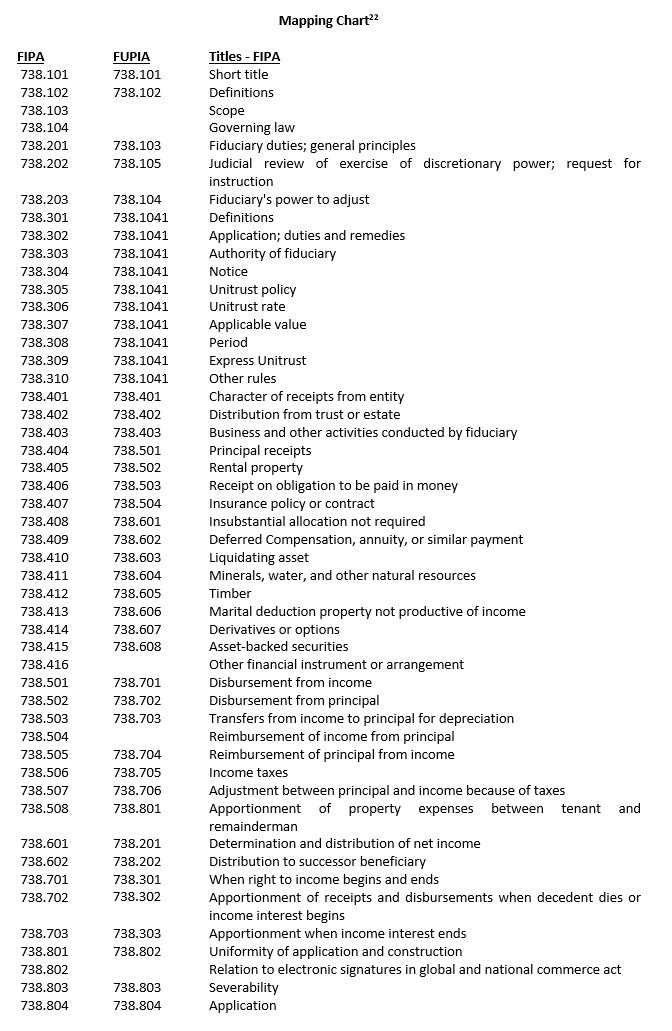
Originally introduced in 2002 under FUPIA Fla. Stat. § 738.1041 (2002), unitrusts have become more commonplace, and FIPA replaces the lengthy section of 738.1041 by splitting it into a series of smaller more discrete sections found in Fla. Stat. §§ 738.301-738.310 (2024). This adjustment also aligns with the numbering of the 2018 Uniform Act. These provisions apply to (1) income trusts (unless the trust instrument expressly prohibits application), (2) express unitrusts (other than Charitable Remainder Unitrusts), and (3) previously converted unitrusts. Upon notice to beneficiaries, Fla. Stat. § 738.303(1) (2024) permits a trustee to convert an income trust to a unitrust, change the percentage of the unitrust rate or method used to calculate the unitrust amount, and convert a unitrust to an income trust.[13] Court approval is not required, though the fiduciary may request a protective order before converting to or from a unitrust.[14]
The Act maintains existing Florida law that the Unitrust Rate must be within the federal tax safe harbor of at least 3% and not more than 5%.[15] Although the Act permits a trust settlor to deliberately veer from the 3-5% safe harbor, it's crucial to exercise significant caution when planning beyond this limit.
Section 738.310(1)(a) offers one of the main changes from FUPIA, providing the trustee with a new tax ordering rule to ascertain the federal income tax attributes of the unitrust amount, if the trust is a converted unitrust under §§ 738.303(1)(a) or prior law.[16] Under the new tax ordering rule, unitrust distributions consist of (1) net accounting income, (2) ordinary income not allocable to net accounting income, (3) short-term capital gains, (4) long-term capital gains, and (5) principal.[17]
FIPA makes several other changes to current law:
- Separates provisions relating to unitrusts into distinct sections, making them more visible.
- Specifies that these sections apply to estates only where a trust is a beneficiary of an estate.
- Adds definitions applicable to a unitrust, including “applicable value,” “express unitrust,” “net fair market value of a trust,” “unitrust,” “unitrust policy,” and “unitrust rate.”
- Ensures that the unitrust provisions remain within the safe harbor standards of the Treasury Regulations (as they are under current law) but allows for future modification of the relevant provisions should the Treasury relax those standards.
- Modernizes but does not substantially alter provisions relating to a fiduciary’s authority and duties as they relate to unitrusts; the method for determining the unitrust rate; and the method for determining an asset’s fair market value for the purpose of determining the unitrust amount.
5. Receipts from Entities
FIPA updates the guidelines for distributions from entities by amending Fla. Stat. § 738.401. The existing law favors objective calculations over fiduciary discretion.
As we move from FUPIA to FIPA, notable changes include:
- Limiting the lookback period to three accounting periods (current and prior two periods, or duration of time held by the fiduciary, if less) to simplify trust administration. Previously, there was an unlimited lookback period.[18]
- Restructuring the law to more closely match 2018 Uniform Act’s overall organization and terminology (e.g., "partial liquidations" are now called "capital distributions").
- Amending or adding definitions, including “capital distribution,” “entity,” and “entity distribution,” to clarify certain concepts incorporated into this section.
6. Allocations Deferred Compensation Accounts, Annuities, and Similar Arrangements
FIPA renumbers the section of law addressing receipts from deferred compensation accounts, annuities, and similar arrangements from Fla. Stat. § 738.602 (2002) to Fla. Stat. § 738.409 (2024). Currently, the “income of the fund” is calculated in a specific way, and this amount is compared to the actual payments received from the fund; the smaller of these amounts is then allocated to income, with the balance allocated to principal.
FIPA modifies this section by:
- Changing the phrase “income of the fund” to the more customary “internal income.”
- Specifically authorizing fiduciaries to transfer assets from principal to income as necessary to fully fund the internal income of the fund and distribute such income to the beneficiary.
- Adding an accounting period concept to balance the allocation of intra-period receipts between principal and income.
A special provision for Marital Trusts allows the beneficiary to request the fiduciary to withdraw any remaining internal income that has not been paid out, and in such cases, the fiduciary shall transfer that amount from principal to income and distribute it as income. For all other trusts that have one or more beneficiaries entitled to receive all the current net income, if the internal income surpasses the payment made from a separate fund to the fiduciary, the fiduciary will reallocate the trust's principal to income by the amount of that excess and distribute the same.
7. Other Financial Instruments or Arrangements
FIPA introduces Fla. Stat. § 738. 416 (2024), to be a “catch all” provision for the allocation of receipts and disbursements related to financial instruments not explicitly addressed in FIPA. The rule allocates 90 percent to principal and 10 percent to income, aligning it with the standard for derivatives, options, and asset-backed securities.
8. Transfers from Income to Principal for Depreciation
FIPA modifies Fla. Stat. § 738.503, currently allowing fiduciaries to allocate a reasonable amount of the net cash receipts from a principal asset from income to principal, considering depreciation to such principal, with certain limitations. FIPA largely maintains the existing law, but introduces three significant exceptions:
- Eliminates the safe harbor that previously assumed any amount of depreciation taken for an asset was reasonable.
- Substitutes the term “fixed asset” with “tangible asset” to align with updates made in other sections of FIPA.
- Excludes depreciation for assets treated as liquidating assets.
9. Income Taxes
FIPA renumbers from Fla. Stat. § 738.705 (2002) to Fla. Stat. § 738.506 (2024), a provision which requires a fiduciary to disburse from income those amounts allocated to income and from principal those amounts allocated to principal. Current law also specifies that the same allocation rules apply for a trust’s or estate’s share of an entity’s taxable income, except that principal should be used for amounts exceeding total entity receipts. In addition, a fiduciary must also adjust income or principal receipts, pursuant to a specified formula, to the extent the trust’s or estate’s income taxes are reduced, but not eliminated, due to a deduction for payments made by a beneficiary.[19]
FIPA substantially retains current law but makes a few changes. The most significant being it adds a provision allowing a fiduciary to reimburse the “owner” of a grantor trust for income taxes paid. It also removes the formula outlining the amount distributable to a beneficiary and removes the phrase but not eliminated, as it created confusion.
10. Carrying Value
Florida continues to use "carrying value" for asset valuation without requiring frequent appraisals. The Uniform Act relies on "fair market value" or avoids valuing the asset at all by using a statutorily defined 90%/10% split between principal and income. While FIPA may also use the 90%/10% split for certain receipts/disbursements (Derivatives, Options, and Asset-Backed Securities), Florida policy prefers using the less burdensome carrying value.[20] The 2002 Uniform Act relies on fiduciaries’ estimate of fair market value. FIPA's use of carrying value as defined in the Act simplifies calculations and reduces challenges to fiduciary results.[21] Carrying value may be adjusted with proper disclosure to reflect changes in carrying value applied in a consistent manner; however, FIPA urges caution against arbitrary adjustments.
Conclusion
FIPA modernizes Florida’s law and provides clear, updated guidelines to streamline the administration of trusts and estates in the modern era. It (1) allows for total-return investing under the “modern portfolio theory,” (2) provides for the conversion of an older trust into a unitrust, (3) provides flexibility for more individualized estate planning, and (4) provides a governing law provision to reduce jurisdictional disputes. The key theme throughout FIPA is flexibility, more alignment with the 2018 Uniform Act and other state laws, while retaining Florida specific key public policy provisions.
The authors take sole responsibility for the views expressed herein and these views do not necessarily reflect the views of the authors’ employers or any other organization, group or individual.
This article was originally published in the Summer 2024 issue of ActionLine, a Florida Bar Real Property, and Trust Law Section publication.
The information provided in this article does not, and is not intended to, constitute legal advice; it is for general informational purposes only. No reader of this article should act or refrain from acting on the basis of this information without first seeking legal advice from counsel in the relevant jurisdiction to ensure the information contained herein – and your interpretation of it – is applicable or appropriate to your particular situation.
About Alexander M. Parthemer
Alexander M. Parthemer, LL.M., a member of Jones Foster’s Private Wealth, Wills, Trusts & Estates and Corporate & Tax teams, focuses his practice in the areas of estate planning, probate and trust administration, tax planning, business planning, and transactional corporate law. Alex is an active member of the Real Property, Probate & Trust Law Section of the Florida Bar and the Tax Section of the Florida Bar. He holds a Master of Laws degree (LL.M.) in Taxation from the Graduate Tax Program at the University of Florida.
Endnotes
[1] The Act (HB 1093), as approved, can be found at https://laws.flrules.org/node/9592 (last visited 10/11/2024).
[2] The Uniform Law Commission (ULC, also known as the National Conference of Commissioners on Uniform State Laws, or NCCUSL), established in 1892, provides states with non-partisan legislation that brings clarity and stability to critical areas of state statutory law. The ULC has worked for the uniformity of state laws since 1892. It is a non-profit unincorporated association, comprised of state commissions on uniform laws from each state, the District of Columbia, the Commonwealth of Puerto Rico, and the U.S. Virgin Islands. https://www.uniformlaws.org/aboutulc/overview
[3] The 1997 Uniform Act, as amended, can be found at https://www.uniformlaws.org/committees/community-home/librarydocuments?LibraryKey=8471fb91-472d-4fb3-8788-f8696395996c (last visited 6/29/24).
[4] Other specific Florida provisions in addition to unitrust rules include: rules regarding life estates, and distributions from entities, references to Florida’s elective share regime, and inclusion of carrying value in certain calculations. There remain important aspects of Florida law and are retained in FIPA.
[5] Although one of the authors served on the Committee, opinions express herein are those of the authors and not the Committee, other members of the Committee, RPPTL or the Florida Bar Association.
[6] Fla. Stat. § 738.201(2) (2024)
[7] The Internal Revenue Service allows individuals to give away up to a specific amount of assets each year tax-free under the annual gift tax exclusion. Jean Gordon Carter and Janice L. Davies, Gift Tax, the Annual Exclusion and Estate Planning,https://www.actec.org/resource-center/video/gift-tax-the-annual-exclusion-and-estate-planning (last visited September 25, 2024).
[8] A trust with qualified subchapter S status is eligible to own stock in an S corporation. A settlor can use this type of trust to make a gift of all or a part of the S corporation stock and retain voting power while the beneficiary receives the income and the tax bur den. Rebecca C. Bowen, Trusts as Eligible Shareholders of an S Corporation, https://www.t-mlaw.com/commentary/trusts-as-eligibleshareholders-of-an-s-corporation (last visited September 25, 2024).
[9] The Internal Revenue Service allows a spouse to leave property of unlimited value to his or her surviving spouse tax-free. Such assets may be distributed by a direct transfer from the decedent to the surviving spouse or by an indirect transfer to a qualifying trust for the surviving spouse’s benefit. Peter B. von Stein, Basic Estate Tax Planning for Married Couples: Opportunities for Use of Estate Tax Exemptions, https://www.wardandsmith.com/articles/basic-estate-tax-planning-married-couples-use-estate-tax-exemptions (last visited Sept. 25, 2024).
[10] The generation-skipping transfer tax is a federal tax on a gift or an inheritance that prevents the donor from avoiding estate taxes by skipping over children in favor of grandchildren. However, the Internal Revenue Service allows a person to give up to a certain amount to a qualified recipient to avoid this tax. Troy Segal, what is the Generation-Skipping Transfer Tax, Investopedia (Feb. 7, 2023), https://www.investopedia.com/terms/g/generation-skipping-transfer-tax.asp (last visited Sept. 25, 2024).
[11] Renumbered Fla. Stat. § 738.104 (2024).
[12] Fla. Stat. § 738.804.
[13] Fla. Stat. § 738.303(1)-(4).
[14] Fla. Stat. § 738.303(1); FIPA §738.202(4).
[15] FIPA §§738.306; Treas. Reg. §1.643(b)-1.
[16] Fla. Stat. § 738.310.
[17] Fla. Stat. § 738.310(1)(a)(2024)
[18] Florida’s “lookback period” applies a portion of certain large receipts to income, at a rate of three percent per year.
[19] Fla. Stat. § 738.705(4) (2002)
[20] “Carrying Value” refers to the fair market value of an asset on the date of receipt by the fiduciary. In the case of revocable trusts within the meaning of Fla. Stat. § 733.707(3), the fair market value on the date of the settlor’s death is the carrying value. For assets acquired during the administration of the estate or trust, the carrying value is equal to the acquisition costs of the asset.
[21] Under Fla. Stat. § 738.102(4) (2024), when there is a change in fiduciary, the successor fiduciary may elect to adjust the carrying value of all assets to the fair market value of the assets on the date the successor takes office; provided, the first accounting filed after the election must reflect the updated carrying values. Note, this is also permitted in the case of the resignation or removal of one fiduciary when more than one fiduciary is acting, the remaining fiduciary (or fiduciaries) may elect to adjust the carrying value as of the date of resignation or removal.
[22] Excerpt from the Florida Bar Journal Article, Florida Adopts Uniform Income and Principal Act, Jolyon Acosta and Keith Braun, Florida Bar Journal, August 2024.
About Jones Foster
Jones Foster is a full-service commercial and private client law firm headquartered in West Palm Beach, Florida, with offices in Palm Beach and Jupiter. Tracing its roots back to 1924, the firm has served as an integral part of South Florida’s growth and prosperity. Through a relentless pursuit of excellence, Jones Foster delivers original legal solutions that help clients, colleagues, and the community to move forward. A significant number of attorneys have received the designation of Board-Certified Specialist by The Florida Bar in their specific practice area. The firm’s practice groups include Complex Litigation & Dispute Resolution; Corporate & Tax; Land Use & Governmental; Private Wealth, Wills, Trusts & Estates; Real Estate; and Trust & Estate Litigation. For more information, please visit www.jonesfoster.com.